
The Trustless Operating System for sovereign computing.


Under the hood, NONOS takes a radically different approach to operating system design, prioritizing security and trust at every level. Here are some key aspects of how it’s built:

NONOS is written in Rust and uses a microkernel architecture. Rust is a modern programming language that guarantees memory safety, meaning common bugs like buffer overflows or use-after-free errors are virtually eliminated at compile time.
By implementing the core OS in Rust, NONOS prevents an entire class of vulnerabilities that plague software written in C/C++. The microkernel design keeps the kernel very small and limited to essential functions, while drivers and services run in isolated user space with the least privileges necessary.
This way, even if a component misbehaves, it’s sandboxed from the rest of the system. There’s no monolithic, massive kernel with endless drivers (and potential bugs) here, just a tight, secure core.
The system runs directly from memory and is largely read-only. By default, NONOS does not write any system state to disk while running.
The OS image is loaded into RAM and operates there; all apps execute in memory, and unless you explicitly save something, nothing touches the host storage. This stateless design means that if malware somehow executes, it can’t implant itself on a drive, it lives only in RAM and is gone on shutdown.
It also means forensic traceability is minimized (great for privacy) and that the OS remains lightning-fast since it’s not constantly reading/writing to disk. The entire system is essentially rebuilt fresh on each boot from a known-good image.

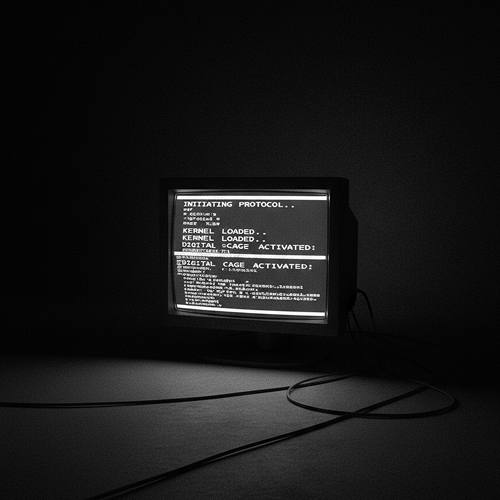
NONOS doesn’t use the typical “download an installer” approach. Instead, applications on NONOS come as secure capsules, cryptographically signed modules that include a manifest of what they’re allowed to do. Think of each app as coming with its own permissions and identity baked in.
The OS will only run these if the digital signature checks out (meaning the code is exactly what the developer published, with no tampering) and it will enforce the capsule’s declared policy (for example, an app might be allowed to access your camera but not your documents folder, if its policy says so). Unknown or unsigned code simply won’t run on NONOS, period.
This dramatically reduces the risk of rogue programs. Even malware disguised as a legit app would fail signature checking and be blocked. In essence, every program is a known quantity with limited capabilities, a huge departure from the free-for-all execution model of traditional OSes.
NONOS can prove its own integrity. Using techniques like secure boot and attestation, the system ensures that when it loads, it’s running genuine NONOS code not altered by any attacker. Moreover, thanks to integrated zero-knowledge proof technology, NONOS can generate a cryptographic proof that a given capsule app ran correctly on authentic NONOS hardware.
This is cutting-edge, it means third parties could verify that (for example) a financial transaction or a computation was executed in a secure environment, without needing to see the actual data.
This “proof of execution” concept opens doors for things like trustworthy cloud computing and blockchain use cases. In everyday terms, it’s like having a notary for your computer’s operations, certifying that everything is above board.
Supply chain risk is exploding:
third‑party involvement doubled from
of breaches. Check this link →
Unlike legacy systems that bolt on new tech years later, NONOS was designed with emerging technologies in mind. It comes Web3-ready out of the box. For instance, there’s an integrated Ethereum cryptocurrency wallet in the OS itself, operating as a cold wallet when NONOS is offline. Your private keys can be stored securely (isolated from the internet when not in use), which means you don’t need to trust third-party wallet apps, the OS handles it at a fundamental level.
NONOS also introduces “zkAuth” (zero-knowledge authentication) for logins, a mechanism that allows you to prove your identity or rights to a service without handing over your personal data or passwords. It’s a privacy-preserving way to authenticate: the website or service gets cryptographic assurance it’s you, but never sees your actual credentials.
Additionally, NONOS supports decentralized, encrypted networking; devices can form a peer-to-peer mesh where communications are onion-routed and censorship-resistant. All these tech-forward features (crypto, decentralized networking, zk-proofs) indicate how NONOS isn’t just catching up to the present, it’s built for the future of computing.
The core of NONOS is open source, allowing the security community and developers to inspect the code. There are no “black boxes.” This transparency builds trust, anyone can verify the OS does what it claims and has no backdoors.
It also means NONOS can evolve rapidly with community contributions, much like Linux but with an even sharper security focus. By being open and using formal methods (like Rust’s safety guarantees and cryptographic proofs), NONOS invites verification at every layer.

In summary, the technology behind NONOS combines the best of modern computer science, memory-safe programming, minimal attack surface, strong cryptography, and decentralized principles. It’s an OS engineered from scratch to be trustworthy.
Where traditional systems grew incrementally (and inherited many weak points), NONOS started with a clean slate, applying “zero-trust” principles from the kernel outward.
For the user, these under-the-hood choices mean you’re standing on a far more solid foundation whenever you use NONOS.

The Trustless Operating System for sovereign computing.